

Abstract
What changes when agents become both a new unit of programming and an emerging new unit of human-to-machine interaction? The mission of Project Solara, a new software platform coupled with tailored hardware solutions, is to pioneer agent-first experiences that are shaped around you: your agents, your tasks, your environment, under your control. So, what’s different this time from previous generations of computers? Agents and AI accelerate the creation of even more specialized computers without incurring the full cost and tradeoffs that in the past limited the creation, diversity, and specialization of those new forms. We imagine a diverse ecosystem of agent-first devices, from small to large, from fixed to hypermobile, from personal to professional. We’re starting this journey with two concepts designed for the enterprise—and we’re excited to navigate this transformation with you all.
I manage the Applied Sciences Group, an interdisciplinary team that brings together product engineering, research, and the sciences to explore what comes next in computing. The rise of agents is changing not only how software is built, but how people interact with computers—and ultimately, what new kinds of computers may become possible. We are excited to give you an early look at where we believe computing is headed, and what the next computer may look like.

The next computer
When we think of a computer, we tend to picture something familiar: a laptop, a phone, maybe a tablet. But computing has never really stood still. It keeps moving closer to us, closer to the work, closer to the moment where it can provide the most value.
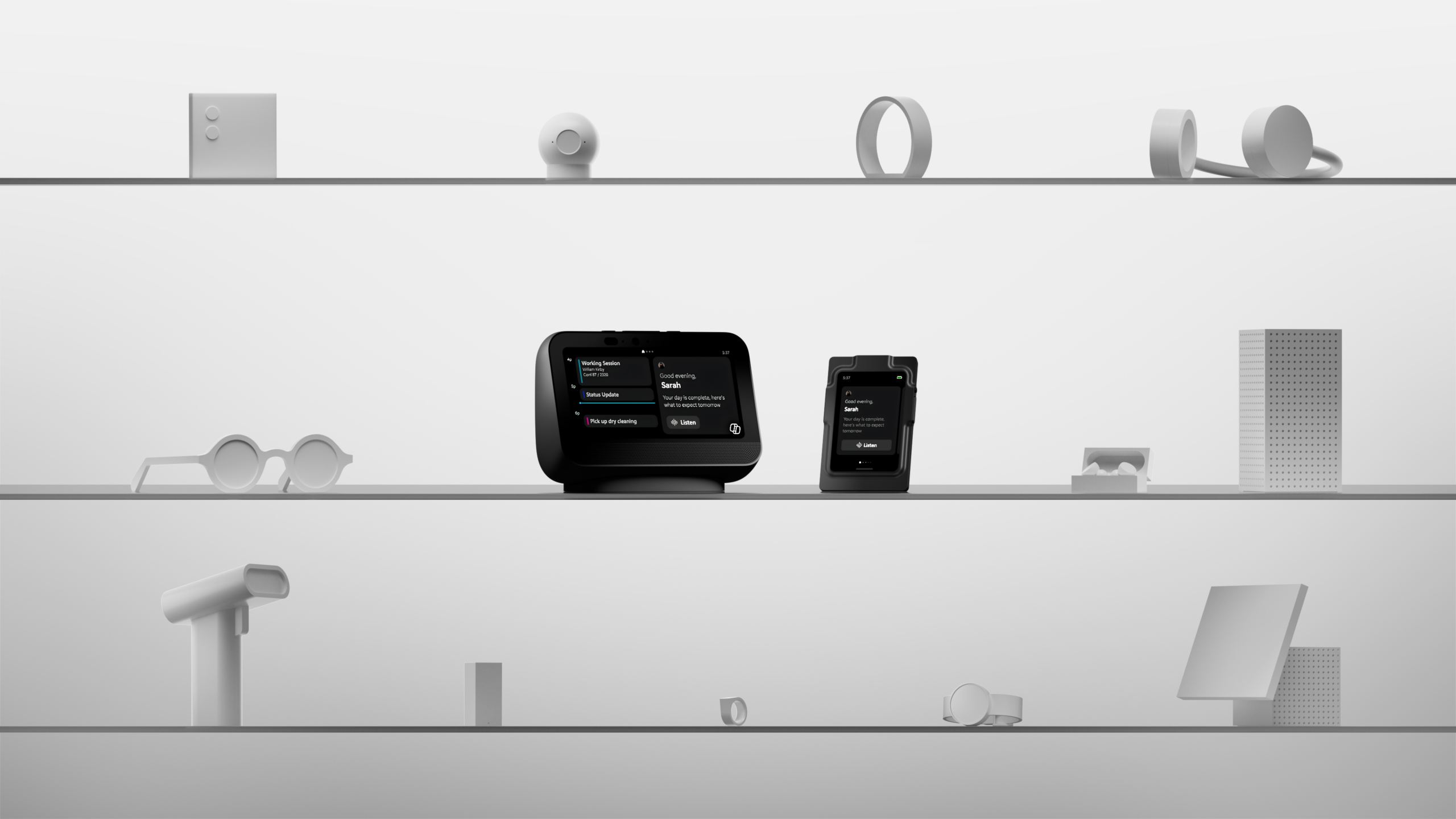
Mainframes did not disappear when PCs arrived. PCs did not disappear when phones arrived. Phones did not disappear when watches arrived. Each new form became more specialized, closer to you, closer to the solution you need. Each one found a new place in our lives because it was better suited to a specific context, a specific task, or a specific moment. So, what’s next?
Agents as the new interaction technology
At Build 2023, I shared my perspective on three emerging AI application structures, shaped by how AI functions relative to your application: Is the AI beside your app, inside it, or outside it?
In the first application structure, the AI is beside your application, it’s like a helper. It keeps the original app architecture and is minimally disruptive to what our customers already know.
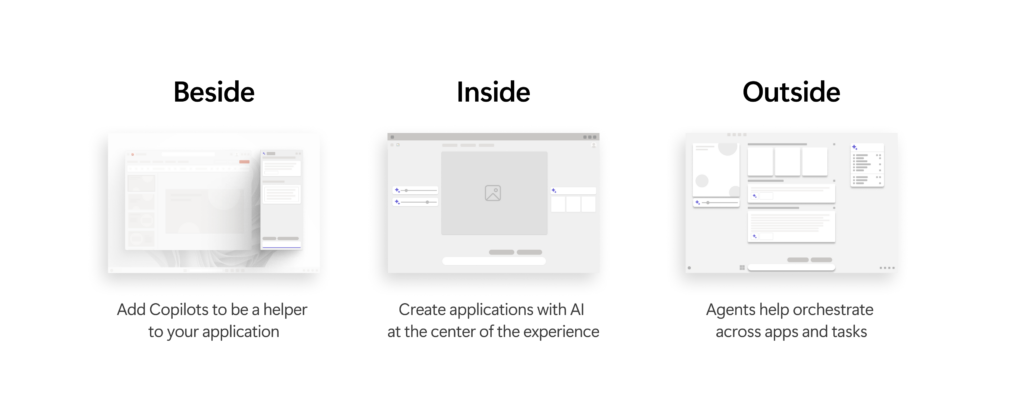
In the second application structure, the AI is inside, as part of the main scaffolding; it becomes the main input loop. Here, AI is used to redefine the application’s interaction model and even its purpose. The experience becomes less dependent on point-and-click commands and becomes more automatic. This is where we are seeing the emergence of agents (for example, Researcher and Agent Mode in Office) and AI-first applications.
The third AI application structure is where AI moves from operating within the application frame to operating outside it, globally. Here, AI orchestrates across multiple apps and services, allowing the agent to connect, coordinate, and maintain context across entire workflows, across devices, and even across very different timescales. Current examples include the recent emergence of various claws (like OpenClaw and Lobster), coworker-like agents, and similar systems.
And so here we are today where agents are a new unit of programming and the new unit of human-to-machine interfaces, changing the way people interact and use their computers. And as we have seen many times in the past, new interaction technologies enable new types of computers.
New interaction technology enables new types of computers

Every new computer form factor follows this pattern shown above. A jump in processing power, both in the cloud and at the edge, has enabled us to create hyper-complex software (AI), making agents possible. Through these agents, human language and dialog is the new interaction technology. For the first time in our history, we can program, direct, and initiate action with computers the way we talk with each other. This higher mode of interaction enables the computer and us to be less dependent on the traditional way we have interacted with computers via keyboards, screens, or even premediated apps. … And because of these trends, we are seeing a major opportunity toward new types of form factors.
As AI streamlines the traditional development stack, these emerging form factors make it possible to bring agents into places, workflows, and moments that previously were difficult or cumbersome. A more specific and better tool for more specific tasks.
That is the opportunity in front of us: agent-first devices.
Agent-first devices accelerate specialization
Historically, specialization has been expensive. If you wanted to create a new type of computer, you had to build almost everything: hardware, software, services, developer tools, UI patterns, management systems, security models, and an ecosystem. This custom stack has been both a hurdle and a moat for new computer form factors.
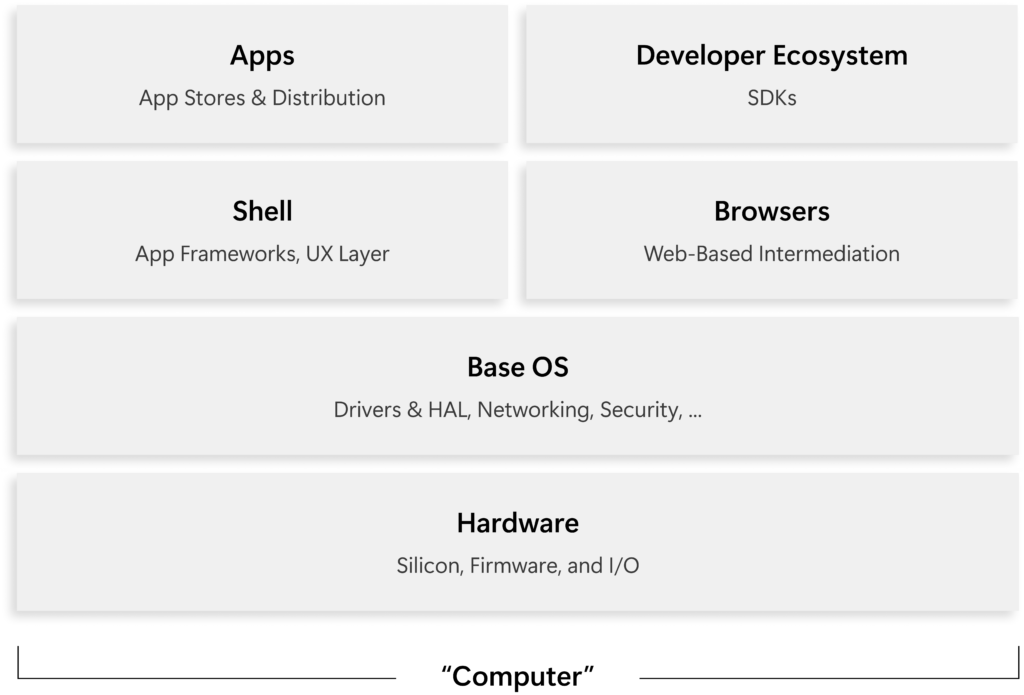
Take a look at the diagram above, which illustrates the typical technology stack for a computer. Not just for laptops, but phones, watches, wearables, industrial devices, and so forth. Each layer in that stack represents a major company or even an entire industry. Bringing a new type of computer to market has historically required building out or modifying nearly every layer. This is expensive, difficult, and takes time. But what if it didn’t have to be that way?
AI, and the new agent interaction model, reduces this burden. AI introduces new UI and app model flexibility into those layers. With just-in-time UI (see below), fewer apps need to be written for specific hardware implementations. With agentic coding, less effort needs to be spent refining a developer SDK for human consumption. As agent-only experiences grow to cover more of users’ needs, less of the traditional UX surfaces (like app frameworks or even browsers) need to be implemented for the specific hardware. The boundaries between those layers will blur and, in some cases, disappear.
Therefore, agents enable us to create new types of computers that are more specific, more contextual, and closer to where they add value, without rebuilding the entire stack every time. This is the mission of Project Solara.
Introducing Project Solara
To enable this new era, we are introducing a chip-to-cloud platform, codenamed Project Solara, designed from the ground up for agent-first experiences and the new device form factors they enable. Chip-to-cloud sounds funny, I know, but what it really means is that the “operating system” is liminal, transcending the device and the cloud. The system brings a lightweight window to the edge, where the agent manifests and where the state, via Azure, can encompass a constellation of specialized devices.
This is not just about bringing intelligence to the PC, the browser, or the phone. It is about bringing intelligence into the places where people need it most: in the flow of work, in the environment, and closer to the task at hand.
We are building this platform on a simple premise: The next platform shift is from apps to agents—from software you open to intelligence you invoke; from graphical interfaces of buttons to expressing intent through agents; and from AI operating inside your applications to agents working outside and across your apps, workflows, and devices.
This is not just about asking an agent questions. It is about giving people a more direct way to reason over their work, context, tools, and workflows—without navigating every app, notification, or interface layer.
And because we believe the future will not be defined by one agent, Project Solara is designed for an open, multiple-agent world. Organizations will use Microsoft agents where they add value. They will also source or build their own agents for their specific workflows and requirements.
The platform must bring these agents together coherently, while respecting boundaries between data, domains, identities, and organizations. That is why enterprise manageability, identity, security, privacy, and user control are not afterthoughts. They are part of Project Solara’s foundation.
We are also investing in just-in-time UI: the ability for an agent experience to adapt across devices and modalities without requiring developers to redesign everything for every new form factor. Today, that means semi-structured approaches like adaptive cards and known content types. Over time, it moves toward more dynamic and generative interfaces. This is what makes specialized form factors viable.
We are previewing concepts that explore two very broad categories: stationary and portable. Both are multimodal: glanceable access, voice, vision, and getting to the right agent at the right moment. And investigating several verticals across healthcare, retail, the financial industry, and more.
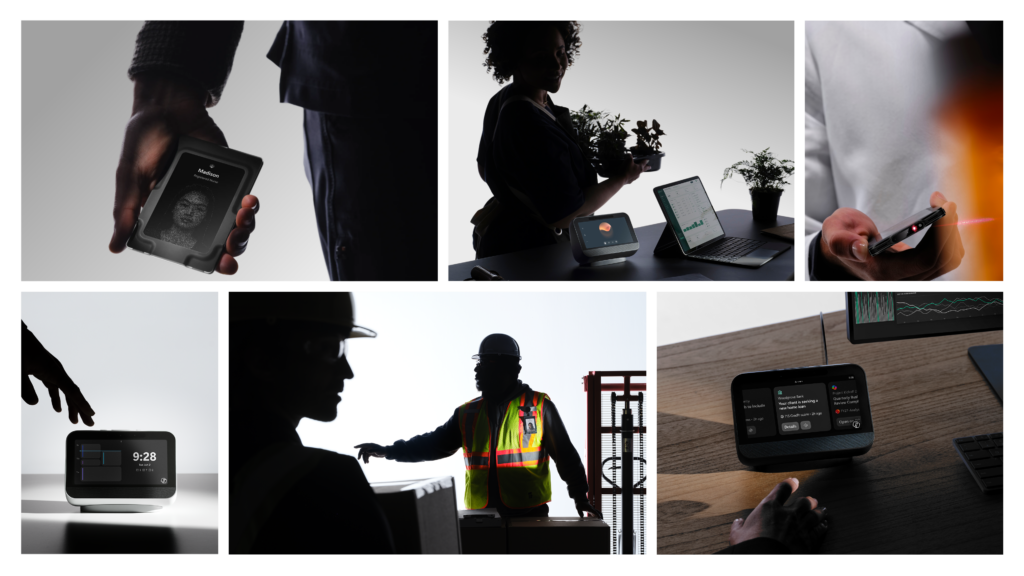
Every place where compute can add value becomes an opportunity to help users achieve more. Every workflow, every environment, every role can have a more specific tool. Not devices built around apps, but devices built around agents—that is the promise of Project Solara. It’s a new way to bring intelligence into the moments and places where people need it most.
We are still early. I don’t want to over-promise. But I also don’t want to understate the significance of the shift. When the cost of specialization drops, innovation accelerates.
More details…
Project Solara is specifically designed for the new era of agent-first devices. It establishes hardware and software requirements that will meet enterprise needs for manageability, security, and privacy, while ensuring critical user experiences are delivered.
The cloud is not the only place intelligence lives. The agent sits between user intent and distributed execution. The UI becomes more like an adaptive access layer. The device becomes a window into long-running intelligence and action. A human-scale interface layer between the person and a larger intelligent environment.
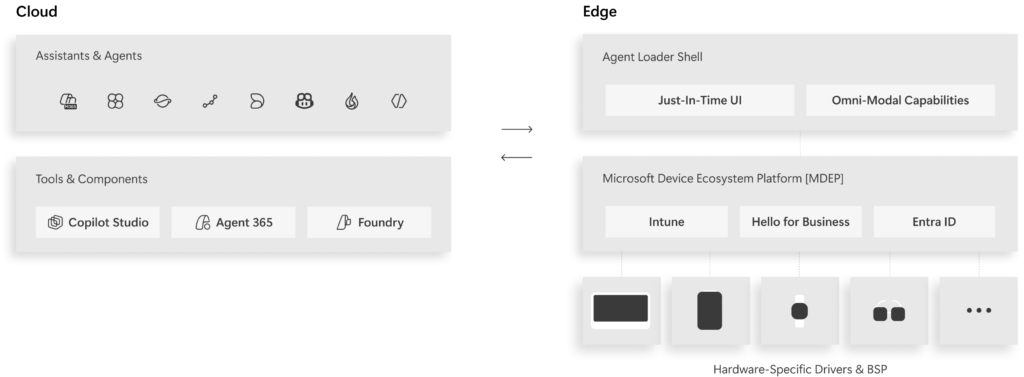
Three pillars to the platform:
- Enterprise-readiness, with privacy, security, control, and trust
- Agent-driven interaction model with just-in-time UI
- Extensibility to bring your own agents
Enterprise-readiness, with privacy, security, control, and trust
Seamless access to your agents must be balanced with transparency and control, so enterprise customers, device users, and the people around them can understand and control how these devices are used.
We are building the Project Solara platform to support enterprise-level hardware and software manageability, security, and privacy protections to securely access services such as WorkIQ. Project Solara includes reference designs that are flexible to modify to accelerate building and customization.
Device-side attributes of Project Solara:
- Microsoft Device Ecosystem Platform (MDEP) is an enterprise-grade operating system built on AOSP, designed to meet the highest standards of security, reliability, ease of deployment, and innovation—enabling device makers to build and deploy at scale.
- Agent Shell that can dynamically load and tailor multiple cloud-based agents.
- Microsoft Intune allows IT administrators to manage and secure these devices just like PC and mobile devices today.
- Entra ID so users can use their existing Microsoft accounts.
- Hello for Business with at least one biometric authentication method, like facial recognition or fingerprint, allowing seamless access to the device.
- Easy privacy controls like a physical mic mute button, and clear indicators when listening or recording.
- Approved chipsets accompanied with applicable reference designs.
These attributes represent our current thinking and will continue to evolve as we continue to build out the platform.
Agent-driven interaction model with just-in-time UI
These new devices are not meant to run traditional apps. They are designed for agents. That shift gives us more flexibility in the user interface, because the experience can adapt to the device, the screen size, the content, and even the mode of interaction—whether visual, voice, touch, or multimodal.
Every new device form factor has traditionally required its own application model, UI patterns, and optimization work for screen size, resolution, runtime, and input method. That is one reason new device categories are so expensive to build, and why they can struggle without a strong app ecosystem behind them.
AI changes that equation. We are already seeing models generate content, images, and layouts tailored to different contexts. If those capabilities become part of the agent loop, an agent can adapt its visual, voice, or multimodal interface to the device it is running on, without forcing developers to redesign the experience for every form factor. We call this broader capability just-in-time UI.
Just-in-time UI exists on a spectrum defined by how much structure is required to render an experience. On one end is responsive UI: highly structured interfaces that reflow predictably across screen sizes. On the other end is fully generative UI: a future state in which AI can create the interface frame by frame with minimal predefined structure. That future is not here yet, but we can already see early signs of it.
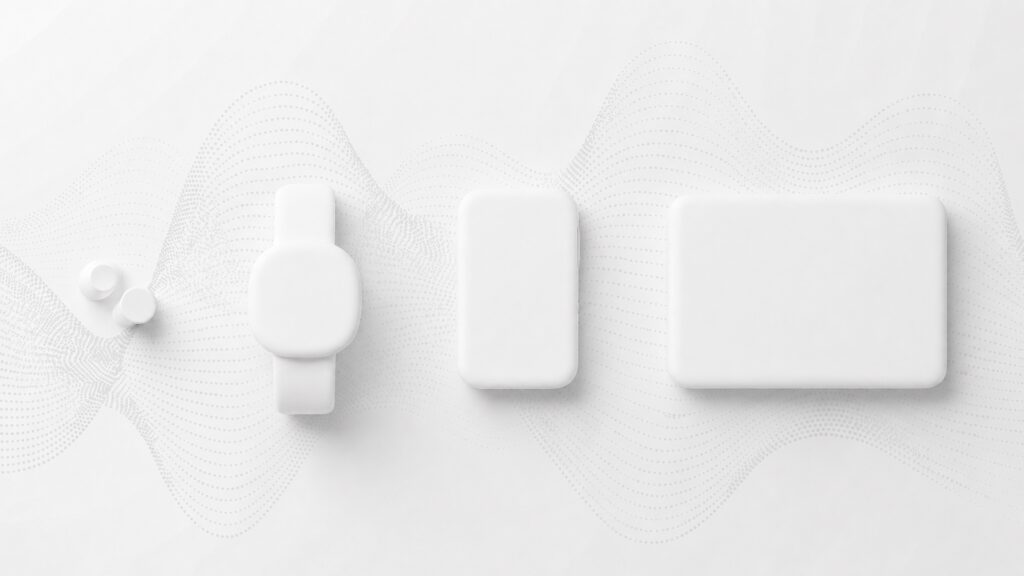
Today, Project Solara is intentionally building for the middle of that spectrum—beyond traditional responsive design, but not dependent on unconstrained generation. That gives agents enough flexibility to adapt their presentation across very different devices while preserving consistency and usability. In practical terms, the same agent can render a custom experience on multiple screen sizes and modalities with little or no additional work from the developer. For us, that is the first proof point: a path to specialized devices without requiring developers to rebuild the experience from scratch each time.
Extensibility to bring your own agents
One of the most important realities of this new era is that there will not be a single dominant agent.
Instead, we are entering a world of many specialized agents, each optimized for different skills (coding, communication, analysis, etc.), datasets and domains, organizational scopes and requirements. Just like no single app could replace Word, Excel, and PowerPoint, no single agent can meet every need.
This creates a critical challenge: How do you bring multiple agents together into a coherent experience? The most straightforward approach is manually launching agents like launching apps. But soon the user will want more sophistication, more automation, and more coordination. We are working on various software technology for delegation to specialized agents, like an agent dispatcher and an agent task manager, which can automatically activate or surface agents when needed.
Concept reference device designs
We’re developing concept designs to test and pilot the Project Solara platform. These concept devices are not meant to define the limits of the platform, but to show the range of what becomes possible across stationary, portable, wearable, and hyper-mobile experiences.
While these designs may not become the exact shipping experience, they help inform the platform and experience needs to get us started—and show the power of an agent-first interaction model: devices can be shaped around the agent, the environment, and the workflow, instead of forcing every use case into the same general-purpose form.
Silicon partners
MediaTek and Qualcomm are the first silicon partners working with us to deliver solutions to support Project Solara, starting with initial concept designs and expanding to a broad set of form factors in the future.
With Qualcomm, we’ve worked closely on a portable-device concept-reference design. Qualcomm is a leader in silicon for wearables and other new form factors for intelligent devices.
“Microsoft’s Project Solara is an important step in advancing agent-first experiences across a wide range of devices and form factors,” said Dino Bekis, Qualcomm Senior Vice President for Personal and Wearable AI. “With deep experience enabling the majority of today’s wearable experiences and bringing advanced AI to billions of mobile devices, Qualcomm Snapdragon platforms are uniquely optimized for agentic AI—combining high performance with industry-leading power efficiency. We’re proud to partner with Microsoft to help accelerate this next era of intelligent, personalized computing.”
With MediaTek, we’ve worked closely on the development of a stationary device concept design. MediaTek has deep expertise and a breadth of device partners across the IoT ecosystem.
“At MediaTek, we’re bringing intelligence to edge devices with best-in-class silicon,” said Vince Hu, MediaTek Senior Vice President & General Manager, Data Center & Computing. “Microsoft’s Project Solara platform will significantly accelerate the opportunity for agent-first experiences and devices. We look forward to our continued collaboration, building from the first device concept to an extended ecosystem of Project Solara-powered devices.”
Portable reference design: Badge concept device
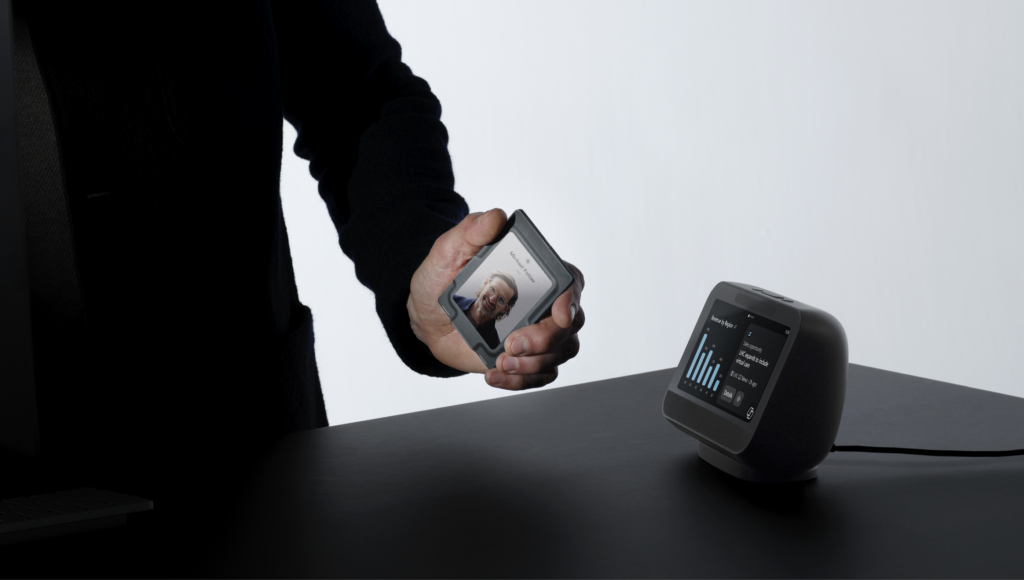
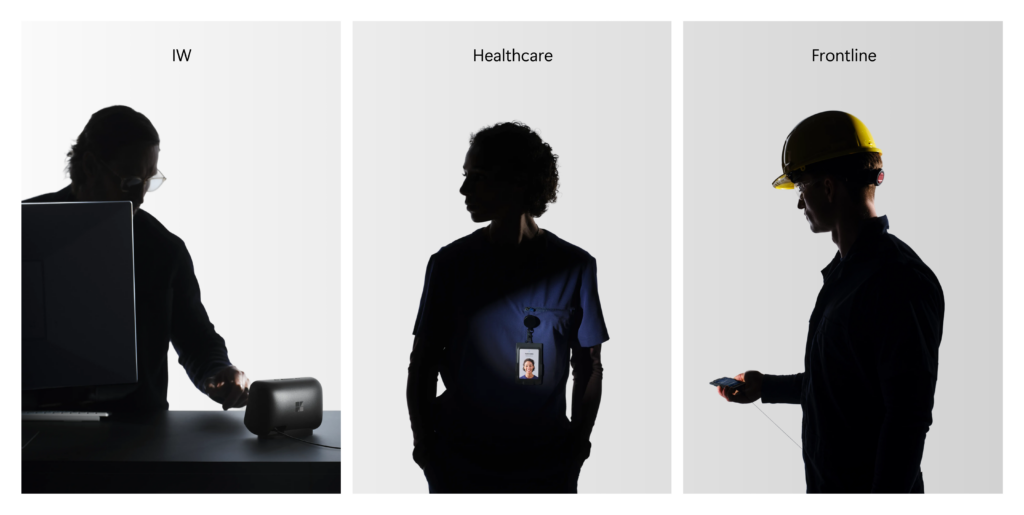
We’ve reimagined a form factor that information workers, nurses, front-line workers, and millions of others use every day: the access badge. This on-the-go, lightweight, always connected companion empowers each person to do more by having their agents always by their side.
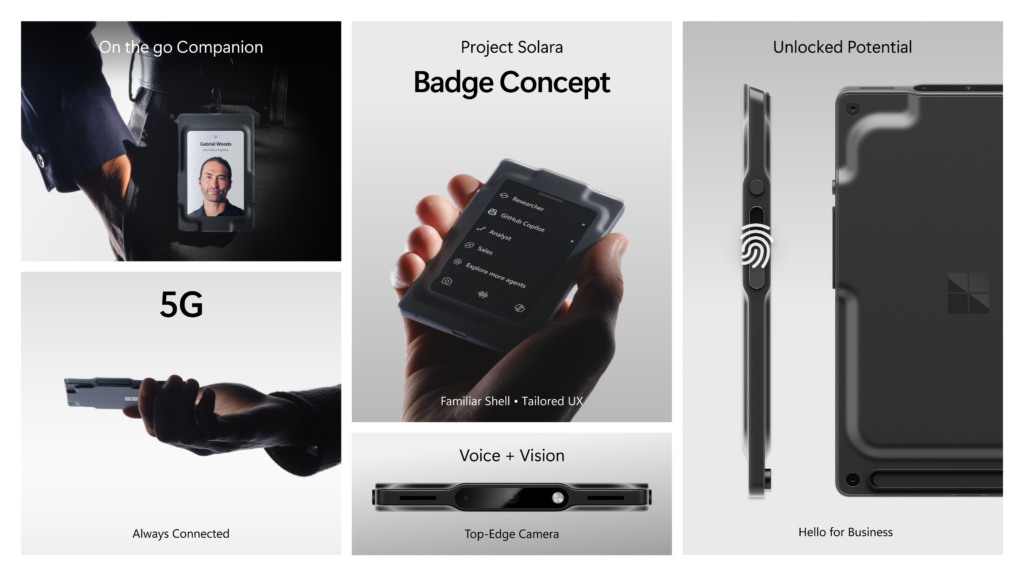
Device capabilities include:
- Touchscreen display
- Hello for Business fingerprint sensor button, allowing secure access to the device and agent
- Privacy switchand volume controls
- Far-field high SNR microphone array and speaker
- Side-facing camera
- WiFi, Bluetooth, GNSS, and 5G wireless connectivity
- Qualcomm wearable silicon
With Hello for Business with fingerprint recognition, you are always a touch away from your agents, so you can quickly glance at what’s coming up next with your Priority Agent, or be one tap away from recording an impromptu hallway conversation with Facilitator.
Using the integrated camera, the platform allows agents, with user permission, to better understand and help take action on the environment around them.
In-place reference design: Desk concept device
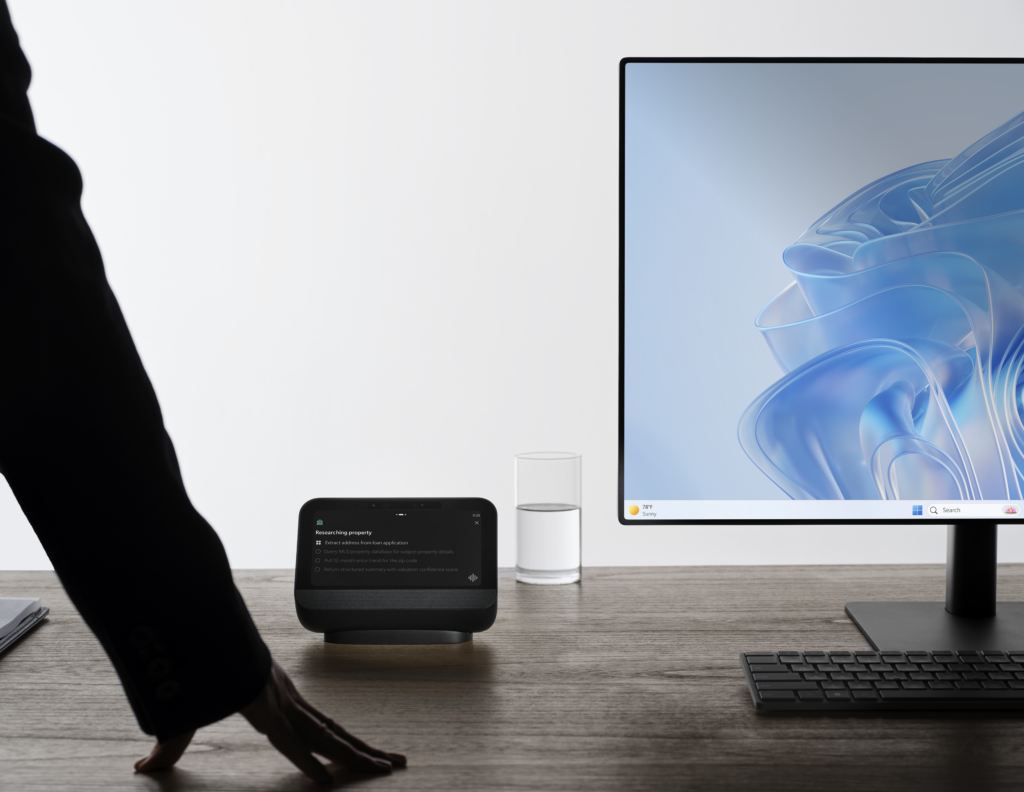
For our next concept, we thought deeply about where many of us spend a lot of time today already: our desks. Whether your desk space is limited, or you’ve maximized your config with multiple monitors, we’ve designed a humble yet helpful companion providing frictionless access to your agent to help you stay in your flow.
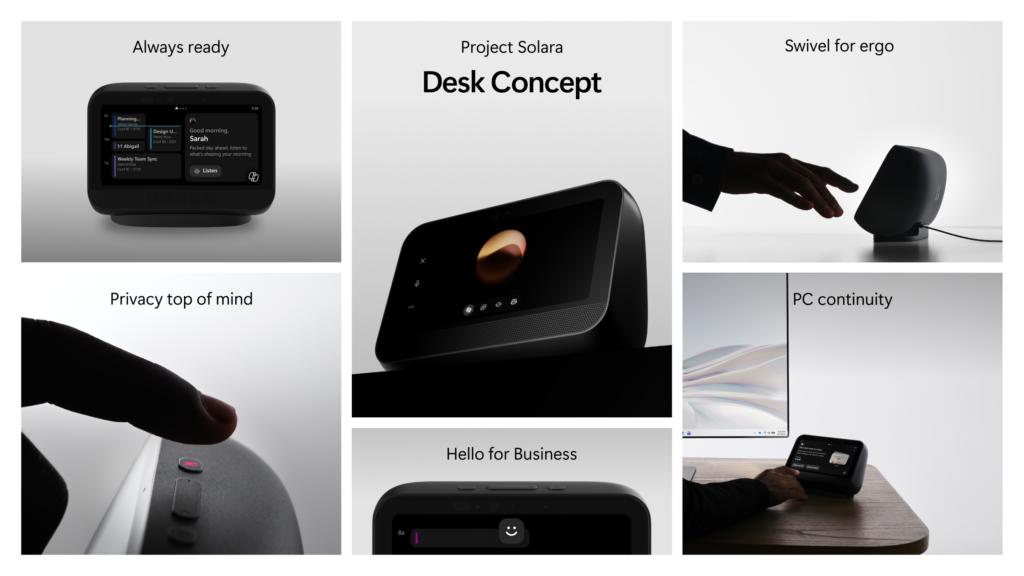
Device capabilities include:
- Touchscreen display
- Hello for Business with face authentication
- Privacy lock buttons
- Microphone mute and volume buttons
- Dual far-field microphone array and full-range speaker
- UWB presence sensor
- 2 USB-C ports for power and optional external display or peripheral
- WiFi and Bluetooth wireless connectivity
- MediaTek IoT silicon
Hello for Business enables enterprise grade protection and enables frictionless authentication to glance access your calendar, stay on top of only the most critical items through curated Priority Cards, or tap into the ultimate thought partner with Microsoft 365 Copilot voice that is grounded on your WorkIQ data.
This desk concept can work stand-alone, serve as a companion to your Windows PC, or even become your cloud PC through Windows 365 when connected to an external display. As a companion, it pairs with your PC via Bluetooth, enabling you to hand off tasks between the devices and keep lock state consistent. Plug in a display via USB-C, and the desk agent device can transform into your Windows 365 client—providing access to both the power of your full Windows 365 experience and the benefit of an agent-first device experience.
Together, the badge and desk concept devices show what becomes possible when agents are no longer confined to one app, one screen, or one device. They show how agent-first experiences can move across stationary, portable, and wearable forms—adapting to the user, the context, and the work.
Real-world piloting
We are using these concept designs to inform how these form factors and platform can be built. They will become reference designs for the ecosystem to build turnkey solutions. Inside Microsoft, hundreds of employees are already using these concept devices to improve their workday
Here are some of the ways we and our partners are using, building, and experimenting with Project Solara to help users be more productive:
Microsoft 365 ecosystem
- Microsoft 365 Copilot, through conversational voice, is available at tap or (optional) wake word, allowing you to securely access your data, grounded in WorkIQ. Copilot provides daily briefings, becoming your ultimate thought partner to brainstorm, explore ideas, take action, or get coaching.
- Researcher can now help you keep tabs on your long-running projects by providing a more direct way to reach and respond to prompts and share reports when complete.
- Facilitator is more accessible, allowing users one-tap access to securely record an in-person meeting, with all the power of transcription, detecting action items, and ensuring this information is grounded in WorkIQ. Never miss an important outcome or struggle to find your notes.
- Priority Agent is an experimental agent our team is developing to bring actionable insights and actions directly to you. Grounded in signals across WorkIQ, Priority Agent provides the answer to “what needs my attention right now?” Priority Agent dynamically curates this list, adding and removing items intelligently, so you only glance at what’s needed now.
We are also partnering with other teams across Microsoft to explore how Project Solara can help deliver additional value for users:
- GitHub Copilot is exploring how an agent-first approach helps keep developers more in touch with the progress of their coding projects and providing faster ways through new modalities like voice to get things done.
- Dragon Copilot is exploring how agent-first experiences can better support physicians and nurses in the flow of care—helping capture interactions, surface relevant information in-context, and follow through on critical tasks without interrupting their day.
We’re excited to see how the agents from other third parties will find value and reach users in more direct ways, in more natural modalities. Here are ways you’ll be able to build for Project Solara devices:
- Extend Microsoft 365 Copilot with declarative agents or custom-engine agents.
- Use Copilot Studio.
- Build with Microsoft 365 Agents SDK and Microsoft Agent Framework.
We’ll have more to share on other ways to build agents for Project Solara devices in the future.
Private pilot program
In the coming months, we’ll begin piloting this agent-first device ecosystem with industry leaders like AccuWeather, Best Buy, CVS Health, Levi’s, Target, and others.
Platform ecosystem
Realizing the Project Solara platform vision requires close connections across silicon providers, device builders, agent developers, and customers, especially in the early phases of learning and iteration.
We will extend our collaboration with silicon partners to create reference designs for a range of categories spanning portable, ultra-portable, wearable, desktop, and others.
With those reference designs, we’ll enable OEMs and product makers to develop specialized solutions for specific scenarios, environments, across a variety of industry segments—spanning healthcare, retail, hospitality, financial services, legal, industrial, field service, and more—while meeting the needs of enterprise security and management, and seamless access and control for users.
Agent builders will be able to reach more people in more places, using the adaptability of the Project Solara platform to bring their agents into the workflows, environments, and moments where they can create the most value.
People, companies, and other institutions adopting Project Solara will shape the agent-powered, problem-solving experiences that they need.
Together, we will unlock the creativity and energy to establish a broad set of agent-first solutions, empowering everyone to achieve more.
Closing thoughts
I’m excited to share this shift and how we are building a new platform to help usher in a new era of agent-first experiences and devices with our partners.
This is where computing and new types of computers are headed. And importantly, this expands the reach and value of the agents and automation you are already building today.
A device on a desk. A device worn in the field. A device in a hospital, a store, a factory, a school, or a home. Each one becomes a new access point for your agents, and a new way to bring productivity, intelligence, and assistance into places where computing has not reached as naturally before.
Agents will reshape not only software, but the devices themselves.
Because now you can imagine something more: not just an agent inside an app, but an agent delivered through a device purpose-built for a specific place, a specific workflow, and a specific job to be done.
That is the bigger opportunity.
For agent builders: Think big. The agents you are creating today will not be limited to the screens and devices we know today. They will be able to show up across a variety of new form factors—devices designed around them, tuned for them, and deployed into the moments where they can create the most value.
So, if you are developing agents today using Microsoft 365, Copilot Studio, the Microsoft 365 Agents SDK, and if you are using Azure to cloud-scale your solutions, then you are already taking the right steps to be ready for this future.
Project Solara is about making that future easier to build, in a way that is open, secure, manageable, and scalable.
We are still early, and there is more to come. And to me, the direction is clear: Agents will reshape not only software, but the devices themselves.
And I cannot wait to see what you build.