

Every agent interface I use looks roughly the same: a chat window with a textbox where I wait for a response, or a CLI streaming structured output at me. They’re well-designed, and they get the job done. But after spending all day in them, I started wondering why working with agents had to feel so transactional.
So I built Agent Terrarium, an open-source desktop companion app where AI agents live in a little animated world on your screen—wandering around, chasing a ball, wearing hats, and reacting to things happening around them. Not because it’s the most efficient interface, but because it’s fun and it makes you smile.
Why build this?
I learned a ton from this project—about Rust, about Tauri, about simulation engines, and about what it takes to make a digital character feel present instead of just rendered.
But the bigger reason is that creativity and taste are really the most important skills in this era of AI. The frontier is moving so fast that the bottleneck isn’t what you can build anymore—it’s knowing what’s worth building and having the design instinct to make it feel right. We can all generate code now. The harder question is whether what you generate is something anyone actually wants.
Agent Terrarium was my way of exercising that muscle. Do I use it every day? No. But building it sharpened how I think about the relationship between humans and agents, and it gave me an outlet for the playfully creative side of engineering that doesn’t always get space in day-to-day work.
Architecture: Rust simulation, React view
The core design decision was to make the frontend a pure view layer. All simulation, physics, AI dispatch, and game logic run in Rust at 20 Hz. The React frontend polls world state via Tauri IPC and renders to Canvas 2D—it doesn’t own any state.
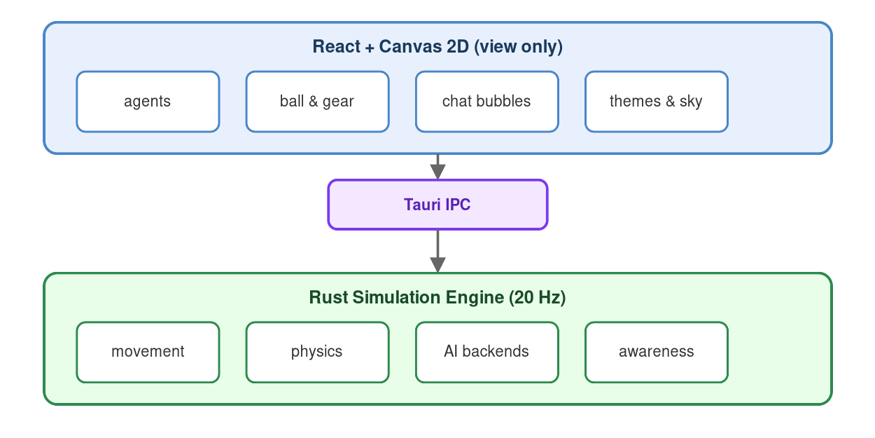
Because the simulation crate (terrarium-sim) is renderer-agnostic, the same engine can drive the desktop GUI, a terminal UI, and (in progress) a VS Code extension. Each tick handles agent movement, ball physics with gravity and bounce and friction, agent-to-agent social interactions, and event emission for the awareness system. This separation turned out to be the most important architectural choice in the project.
The awareness system
This is the part I keep coming back to. Most agent integrations treat the agent as a request-response box where you ask and it answers. Agent Terrarium has a four-level awareness system that lets agents observe and react to world events on their own:
| Level | What the agent sees |
| 0 | Your direct messages only |
| 1 | World events: balls thrown, agents arriving/leaving, theme changes |
| 2 | Social events: other agents talking, emoting, equipping gear |
| 3 | Full world state: periodic snapshots of everything happening |
At level 3, agents receive structured world-state summaries and can respond with actions: say (speak aloud with Animalese-style voice synthesis), emote (show an emoji), move_to (walk somewhere), or run_away. They’re not just answering questions—they’re reacting to their world.
Throw a ball and a Copilot agent might comment on the trajectory. Two agents pass each other and exchange emoji greetings. A new agent arrives and the others have opinions about it. These are small things individually, but together they make agents feel present in a way that turns a utility into something closer to a companion.
Bring your own model
The AI backend is pluggable, with three options out of the box:
- GitHub Copilot via the Copilot SDK, with model selection and tool calling
- OpenAI-compatible endpoints: GPT, Claude, local models, anything that speaks the API
- Echo/NPC mode: no API needed, agents just exist as ambient characters
Each agent is independently configured with its own backend, model, system prompt, awareness level, and working directory. You can have a Copilot-backed coding agent living next to an NPC cat that just wanders around and occasionally judges you.
Themes, weather, and music
The built-in themes range from Meadow (green hills, falling leaves, clouds) to Outer Space (nebula, floating agents, no ground) to city skylines like Seattle with Mt. Rainier and orcas jumping in Puget Sound, or Shanghai with the Pudong skyline and lanterns floating overhead. The theme system is fully pluggable—anyone can create their own, with custom backgrounds, animated decorators, and color palettes. My coworker Klorida made one honoring her Albanian roots, complete with its own skyline and decorations.
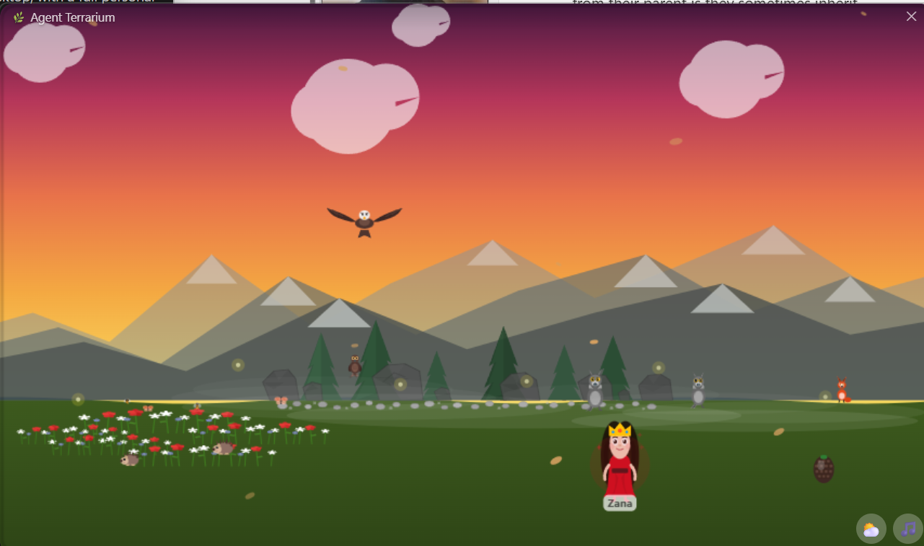
Themes can include animated SVG decorators that follow waypoint or parabolic paths—a swordfish swimming across the ocean, shooting stars at night—and the dynamic sky system ties into your actual local weather. Real-time day/night cycle, dawn/dusk color transitions, rain, snow, fog, and storms all reflect conditions outside your window. If it’s raining where you are, it’s raining in your terrarium.
Each theme also generates procedural lofi music via Web Audio API—no audio files shipped, the soundtrack is synthesized from parameters defined per theme.
Gear, accessories, and file drop
Agents have five equipment slots (hat, face, neck, body, back), and you can right-click any of them to put on hats, scarves, sunglasses, or capes. Gear persists across sessions, so your agents keep their look.
The terrarium isn’t purely decorative, either. You can drag files onto it, type a prompt, and the files get attached to the agent’s task—spec review, code conversion, document analysis, whatever file-based work you’d normally paste into a chat window.
Extensions: Hack without building
Everything visual is extensible through declarative JSON packages. Want a new avatar or a custom theme? Drop a .json file into ~/agent-terrarium/packages/ and hot-reload picks it up without restarting.
A minimal avatar definition:
{
  "id": "my-robot",
  "name": "Robot",
  "icon": "🤖",
  "personality": {
    "speedMin": 30,
    "speedMax": 80,
    "movementStyle": "patrol",
    "ballInterest": 0.5
  },
  "drawSpec": {
    "layers": [
      { "type": "body", "color": "#607D8B", "rx": 12, "ry": 14 },
      { "type": "head", "color": "#78909C", "rx": 10, "ry": 10 },
      { "type": "eyes", "style": "standard", "color": "#00E5FF", "size": 3 }
    ]
  }
}
Avatars are drawn from their drawSpec, an ordered list of visual layers rendered back-to-front. The format is forward-compatible—unknown layer types are silently skipped, so packages built for newer versions degrade gracefully on older ones.
Coming next: VS Code extension
I’m porting Agent Terrarium to run inside VS Code as a webview panel, so your agents live right inside your editor. Same simulation engine, same awareness system, embedded where you already spend your day. The terrarium-sim crate doesn’t know or care whether it’s driving pixels on a desktop canvas, characters in a terminal, or a webview inside an editor—which is exactly why I invested in the renderer-agnostic architecture early on.
Built with GitHub Copilot
The entire project was built with GitHub Copilot as a coding partner—sustained pair programming where every architecture decision, every sprite animation, every physics constant was iterated on together. If you’re curious what that collaboration looks like across a real project with a Rust backend, a React frontend, and an extension system, the full source is open.
Get started
Prerequisites: Node.js ≥ 18, pnpm ≥ 8, Rust ≥ 1.70, Windows 10/11
git clone https://github.com/asklar/agent-terrarium.git
cd agent-terrarium
pnpm install
pnpm tauri dev
Or build an installer with pnpm tauri build, which produces .msi and .exe installers in src-tauri/target/release/bundle/.
The repo has architecture docs, an extension authoring guide, and a contributing guide. Issues and PRs are welcome.
We spend a lot of time talking about what agents can do. I think we should spend more time thinking about what they feel like to be around. When your agent is a little character with a personality, wandering around your screen, occasionally chasing a ball or commenting on something that just happened, it changes how you relate to it. It sparks joy—and that shift, from tool to companion, is worth exploring, even if it starts with something as small as a terrarium.